
Space and Time
https://zingdad.com/publications/books/the-ascension-papers-book-2/7-chapter-1-3-time?dt_dapp=1
Z: Oooookay! So, 8, I feel as if I have finally readied myself and my mind to have a conversation, for which we have, quite literally, been waiting years.
8: It’s true! So much time has passed since you first realised you wanted to talk about time. And it’s going to be a truly fascinating conversation – a conversation of many delightful parts with numerous fun twists and turns.
But now, given that you have already waited SO long for this conversation, perhaps you will humour me and allow me a small tangent before we begin?
Z: Of course…
8: As we sit down to write this together, you have just concluded a time of the year known as the “festive season”. So, I would like to ask you first about this fellow Santa Claus who seems to make such an impact in many parts of the world.
Z: I… uh… Santa?
8: Yes. Could you describe him to me, please?
Z: Sure. I’m not sure where this is going but… sure. He’s known by different names in different parts of the world. Here inSouth Africa as children we called him Father Christmas, for example. But it doesn’t matter what he’s called, Santa Claus is a large, rotund, jolly old guy who wears a red outfit with white fur trim. He is known for making a big belly-laugh as he distributes gifts to children all over the world. He has a sleigh pulled by magical reindeer and…
8: … okay, yes, thank you. You are aware, of course, that you are describing a fictional character to me, aren’t you?
Z: Of course (I laugh), that goes without saying!
8: So, you can describe a person who doesn’t really exist. You can describe him in detail as if you have known him personally. And people all over the world, even people in far distant countries who speak entirely different languages, will also know of this fellow and describe him, his personality, his activities, his nature and his function in the world in very, very similar terms to what you would. Am I right?
Z: Yes. I believe so.
8: It doesn’t matter that he is a fiction. He is still understood the same by many people. But equally, there are people on the planet who know nothing of him at all.
It’s superfluous to my needs to get into the complex relationship between the celebration of the birth of the Christ and the ancient pagan celebration of Yule and this jolly fellow who comes bearing gifts wearing clothing, the colour scheme of which is provided by a corporation that produces beverages. Suffice it to say that there are cultures on planet earth right now that do mark this celebration, cultures that do not mark this celebration and then there are even some small, remote cultures that are utterly unaware of it.
Z: Right. But what does dear ol’ Santa have to do with “time and space”?
8: We’re just about to get there!
Imagine for a moment what it would be like if your belief in Santa made him real. I mean really real. If you believe in him then, like so many children the world over: he is real for you. But the difference in this imaginary scenario is that, if you believe in Santa, his existence will stand up to careful scrutiny! If you believe in him then you see him… then you can travel to the North Pole and visit his workshop. And, if you are observant, you can see his sleigh whizzing by in the night sky on Christmas Eve, dropping off prezzies for all those believers who were “good” that year.
But of course there will also be those who don’t believe in his existence. For them there is no Santa whatsoever. He simply doesn’t exist and there is no evidence to gainsay their disbelief.
Can you see that these two groups of people cannot inhabit the same world?
There must be one reality for Santa believers and another for disbelievers. Quite simply, you cannot have a world in which they co-exist, because in the one reality there is empirical evidence for Santa and in the other it is totally absent. So these are different realities.
And “Space and Time” is a lot like that. You see, “time” is one attribute of the 4th dimension of reality. “Space” is another. If you really, really believe in this little fictional tale called “space and time”, then you can come to live in a reality in which it appears to be absolutely real. When asked, pretty much everyone who believes in “space and time” will describe it in the same kinds of terms. You’ll agree it is real and you’ll all be able to describe your own personal experience of it. There is clear empirical evidence for it and you can study it. And so it is that you are inside the reality of the believers. Only this time you are believers in space and time.
All of the above is really just my way of explaining to you that “space and time” are the same thing, that they are fictional and that they are consensus reality constructs. They are only real for you if you agree that they are real. But if you DO agree that they are real, then there is empirical evidence to show that it is so. And it’s very hard to argue against empirical evidence! So it’s almost as if they are real!
Z: “Almost”?
8: Yes. All illusions can be made to break down if you know where to look. And we will, in the discussions that follow, find some of those “frilly edges” where the illusion breaks down. But, for the main part, just as with your description of Santa, I will be describing the illusion to you: what it is and how it works. Even though I do not live inside the illusion, I am like a person from the world of disbelievers who knows a great deal about Santa and the world of believers. So I can tell you about it from the outside, looking in.
Z: Okay! That sounds good. So where do we start?
The Torus of Space and Time
8: With a shape. Can you picture a torus?
Z: Yes. A donut-shape is called a torus.
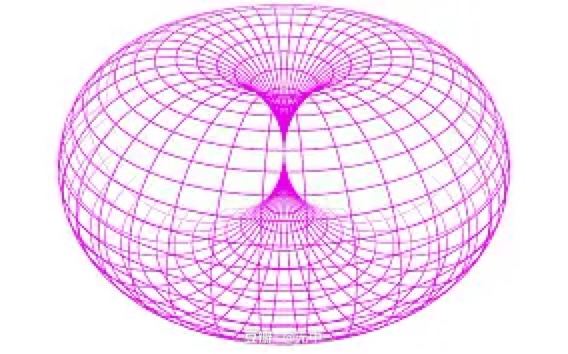
8: That’s one kind of torus. I’d like you to imagine a shape that is halfway between a donut and an apple. Like an apple it is more-or-less round. It is slightly flattened at the top and bottom where it dimples inwards. Like a donut there is a hole that goes right through where the apple core would be. But the difference is that the hole tapers from both the top and bottom so that it meets in the middle at a point.
Z: Yes, I can imagine that.
8: Good. For what it’s worth, this is called a Horn Torus. And if you can imagine such a shape, then you are holding in your mind an image of the 4th dimension of the universe you currently inhabit.
The form of your universe is, at the 4th dimension, equivalent to the surface of a horn torus.
Perhaps this seems like a purely academic thought, but it has some striking implications that will actually give you access to insight and answers to some of the fundamental conundrums with which cosmologists at this point are still wrestling.
The difficulty that arises for anyone on earth that would ponder the nature of your universe is that you are 3 dimensional beings, living in, what appears to be, a 3 dimensional universe. It is nearly impossible for you to discern the form and nature of the 4th dimension and beyond. But coming to these understandings is what will allow you to begin to understand your own true nature and your place in creation. And that is what we will be doing in this conversation.
Z: Wow, okay! I look forward to having you explain that!
8: Good. But before we proceed, I want to make sure that everyone who reads this is on the same page with us, as regards this very special shape. So I am going to place an image in your mind and ask you, please, to find a way to draw that for our readers.
Z: Okay (I get the image), got it. That shouldn’t be too hard… (I go away and do some graphics work and then…).
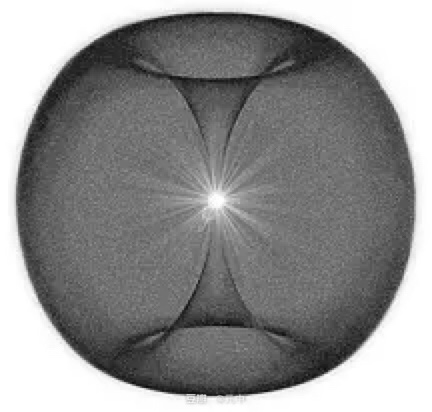
Okay… what do you think of this?
The 4D Universe as a horn torus
8: Not a bad job at all. So, what you have there is a 2-dimensional picture showing a 3-dimensional object that represents a 4-dimensional surface. So it’s a nice picture, but please understand: it’s just a representation. The trick is to extract the understandings implicit in that representation without getting too attached to the universe actually looking like that from your 3-dimensional perspective.
Z: Okay. So, 8, if I understand you correctly then you are saying that the 4th dimensional form of the universe is represented by the surface of this torus. How so?
8: Yes. Let’s get into that. The first thing to be aware of, when looking at that image, is that you are looking at a representation of all of space and time right there in front of you. If you look at a normal map you look at a representation of a piece of land, right? Well imagine you could see a map that showed you that piece of land from the beginning of time to the end. Now imagine you can look at a map that shows you the whole universe for all of time. That is what you are looking at when you look at this illustration all of space and all of time represented in one picture.
If you travel inside the 4th dimension, as you currently are, you do so in a time-like fashion. The easiest way for me to explain that concept is to begin with the bright light at the centre of the torus. See that? That is the universal singularity and is also where the event commonly known as the “Big Bang” occurs.
Let’s begin there.
At the beginning of time a vast quantity of energy is expressed at the Big Bang. From there, the energy expands into the funnel “above” or “after” (depending on your perspective) the singularity. As it expands, so the energy cools and condenses into less energetic states. It becomes matter. Space and time are already there. The form of the horn torus is already there. The energy of the matter is simply travelling across it.
There is more expansion and more cooling. And in this matrix of super-excited proto-matter, beings come and play. Perhaps you’d call them creator-beings. In a way they are like children playing in a stream of water (and they don’t mind me saying so either). They make patterns in the stream and watch as those patterns play out, spinning and whirling away, as the energy and matter continues to expand. And, from here on out, the story gets more and more complex. Too complex to tell of today. The basic point is that there are more and more consciousnesses that come to play and to make and hold patterns in the energy, at every level of scale. Very early on, at the smallest scales, the energy is knit into sub-atomic particles. And then atoms and later molecules. At a larger scale the expanding gasses are given twists and swirls and, as a consequence of these playing consciousnesses, proto galaxies begin to form. And then, later, as those galaxies take shape, stars and planets are spun together inside those young galaxies.
And so, as the matter and energy of the universe begins to exit the horn at the top of the torus, it is already quite cool and there are many very well defined structures knit out of the available energy. And so it is that, at this point, you will find well-defined galaxies including discrete young suns and planets spinning and cycling like wheels within wheels as a consequence of the games of those creative consciousnesses.
From here the expansion continues. Energy expands and matter moves further apart. Stars and galaxies move further and further from each other, seemingly rushing away from each other into an ever expanding night. And from where you are right now inside this time-like progression it certainly might seem as if they will continue to expand eternally outward, as the expansion seems to just go faster and faster.
But, if one steps outside of the bubble of space and time, one can see that there is an equatorial high-point to all of this. Things only expand so far before they begin to contract. And then the matter and energy of the universe moves back towards singularity. As it does, it goes faster and faster. Galaxies begin to draw together. Space begins to shrink. And, at last, as the matter and energy of the universe begins to rush towards itself, it begins to heat up as it compacts again. As the matter of the universe rushes towards itself it begins to collide. Large objects are smashed together and broken into smaller objects. Molecular chains are broken. Then atoms are smashed into a super-hot soup of sub-atomic particles, then pure energy and then… singularity. The Big Crunch. At this point time slows down to a dead halt. All time is now. All space is here. All matter is energy and all energy is one energy. All is One. Singularity!
Z: Wow. That’s so elegant. I love it!
8: It is perforce a huge over-simplification of events, but it does at least give you an overview from which we can work.
Z: There is something I don’t quite understand though. The first half of the journey is expansive from the Big Bang… and then the second half is contractive, ending in the Big Crunch. But you just said it appears to us as if we keep expanding. Can you clarify that?
8: A good, observant question. It comes down to two reasons, both of which have already been covered. The first reason is that you can only see “backwards in time”. You can only see things the way they were. So, as you reach the equatorial high-point of the torus, you can still only see the way things were. And since it is the objects that are the furtherest away that most powerfully show you how objects in the universe move, relative to your position, you will still see everything moving away from where you are. It will continue to look this way for a good while yet. In a few years time it might become possible to discern the changing tide but only to those that are specifically looking for this with the most sensitive of equipment. It will take perhaps centuries before astronomers will see a mix of expansive and contractive signatures in the sky. And it will only be as one enters the Big Crunch itself that an observer would be able to observe no evidence of expansion in the sky at all.
So that’s the first reason.
The second reason is, as explained, movement does not slow down. At the Big Bang, the stuff of the universe is ejected. It is flung outwards with a great deal of force. Things move apart. Then, at some point, those things are pulled towards each other by the contractive forces. If you look at the torus and imagine stars and galaxies moving over its surface, perhaps you can see why there does not have to be a deceleration for this to happen. And so, as astronomers examine the cosmos they notice that the objects of the universe are not slowing in their movement. Couple this with the fact that you are seeing the light of times gone past and logic would seem to dictate that the universe will forever expand. Though this is, of course, not the case.
Z: And, the other thing is, the way you described the movement across the torus, there seems to be a beginning and an end. But there isn’t really one, is there? It just goes on and on.
8: Very perceptive. Energy constantly flows from the singularity and energy constantly returns. The Big Bang is right now. The Big Crunch is right now. But the wave your galaxy is surfing is between these two points.
But really, the first points that you can discover about space and time are already laid bare:
1. It’s all an illusion and doesn’t really exist
2. If you create that you believe the illusion, then you can experience it to be real by being inside of the illusion.
3. Space and time, energy and matter are really “one thing”, although they appear to be separate and different things, and this is what creates the illusion.
Z: Okay, great. But I have some questions.
8: I’m shocked (he jokes). The aforementioned was really only meant to be an introductory framework. There is MUCH more to be said on the subject and this will come from your questions. So, go ahead, let’s hear them…
Can We Distinguish the Horn Torus for Ourselves?
Z: Well, the first thing that comes to mind is: looking at that shape – that horn torus – is it possible for us to discern that shape with instruments, such as telescopes or whatever? I guess what I am asking is, whether we, inside of the illusion, can find a way to see that torus for ourselves?
8: No. The best you can do is to infer its existence. The torus is the shape of the flow of time itself. You experience yourself to be living through moments of time. You can only perceive one “slice” of that shape at a time and, as such, would not normally be able to perceive the entire shape.
To facilitate your understanding of this I am going to remind you of an old friend. Remember Shadowman?
Z: Yes, the flat guy from the discussion on dimensions (Zingdad note: see Chapter 1.1 Dimensions).
8: Right. Well the thing is that he is a 2D being and, as such, cannot perceive depth. He would have profound difficulty even imagining things that are not flat as he is. Even though he is in a room that HAS depth, he can’t perceive that. He cannot perceive the shape of anything at all other than other 2D things, and they even have to be on the same plane as he is before he becomes aware of them. But, if he is a bit of a thinker, there might be ways for him to use what he can perceive of his world to hypothesise the 3rd dimension. And that is exactly what we are doing here – finding ways for you, a 3rd dimensional being to understand the 4th dimension. You are inside a space that has four dimensions, but you can only perceive that indirectly. You are in a shape that you cannot see. You experience it only by travelling through it and you struggle to make sense of this travel.
And so, to come back to your question: I’m afraid no telescope of any kind will allow you to perceive the horn torus. To do so, one would have to be able to see outside of time. Telescopes can, of course, not do this. Telescopes of all kinds appear to be able to look “outwards” – they appear to be able to look across great distances. But that is an illusion. What they are doing is powerfully magnifying a very small, dim portion of what is available right here and right now. It is a function of the illusion of the flow of time that telescopes therefore can only look in one direction… and that is backwards in time.
Z: Okay, so we won’t see the torus with a telescope. But you said something interesting there. What do you mean when you say it appears as if we can only see backwards in time with a telescope?
8: Oh come on! You know this!
Telescopes do not “look outwards”. All they do is concentrate and focus the light that falls upon them. But that light has had to travel some distance to get to the telescope. The very nearest star to your solar system is about 4¼ light years away. In other words it has taken more than four years for the light that shines from that star to reach earth. If you look at Proxima Centauri (the name that star has been given) then you are seeing the star as it was more than four years ago. You are looking into the past. And Proxima Centauri is your nearest star with the shortest transit time. Even with the naked eye you can see stars that are thousands of light years away and galaxies that are millions of light years away (though at such distances they appear to be a single spot of light). So, even with the naked eye, when you look out, you are looking back in time.
With the most advanced telescopes you are able to see some of the earliest galaxies more than 13 billion light years away. If you wish to “see” much further back in time, you will need to look more for energy signatures and less for stars and galaxies. And it is so that there are those scientists who focus on this area of endeavour and they are indeed picking up energetic particles and electromagnetic radiations from the expansion of the singularity nearly 14 billion light years back.
At the risk of belabouring the point… they are not seeing the singularity as it now exists. To do that you would have to be able to see outside of time and that is not possible for you. They are seeing it as it was nearly 14 billion light years back.
Z: Which means it was 14 billion years ago?
8: No, not quite. Light years are a measure of distance. Years are a measure of time from your relative perspective. It would be nice if they equated directly, but they only are not actually the same thing. I am trying to be accurate without confusing you with too much detail. If you like we can address the idea of “relative time” later. It’s really quite interesting but it will take a little work for you to understand. So for now this will have to do: when you look out into the night sky, and particularly when you look with a telescope, you are looking at events in the distant past.
Z: But you said that this was actually an illusion?
8: Indeed. You seem to be seeing backwards in time. But that is a function of the way you are travelling across the surface of the torus. The effect of that travel is the appearance of the march of time. Time does not really exist. It is just movement in the 4th dimension.
The concept I am getting to here is much more far-reaching than a simple understanding of what you are seeing through a telescope, though. So I’d like to take a little time to explain it properly.

